A bowler takes one wicket, then another, then suddenly the crowd starts buzzing. One more wicket on the very next ball and history is made: a hat-trick. It is one of cricket’s most thrilling mini-dramas because everything happens at speed. Three deliveries. Three dismissals. One bowler in complete control.
But what happens when the bowler keeps going and claims six wickets in six consecutive balls? That extraordinary event is called a double hat-trick. It is so rare that cricket fans often debate whether it has ever happened in international cricket.
This guide explains the difference between a hat-trick and a double hat-trick in cricket, the complete rules, the players with the most international hat-tricks, and famous six-wickets-in-six-balls performances from domestic and club cricket.
Quick Summary: Hat-Trick vs Double Hat-Trick
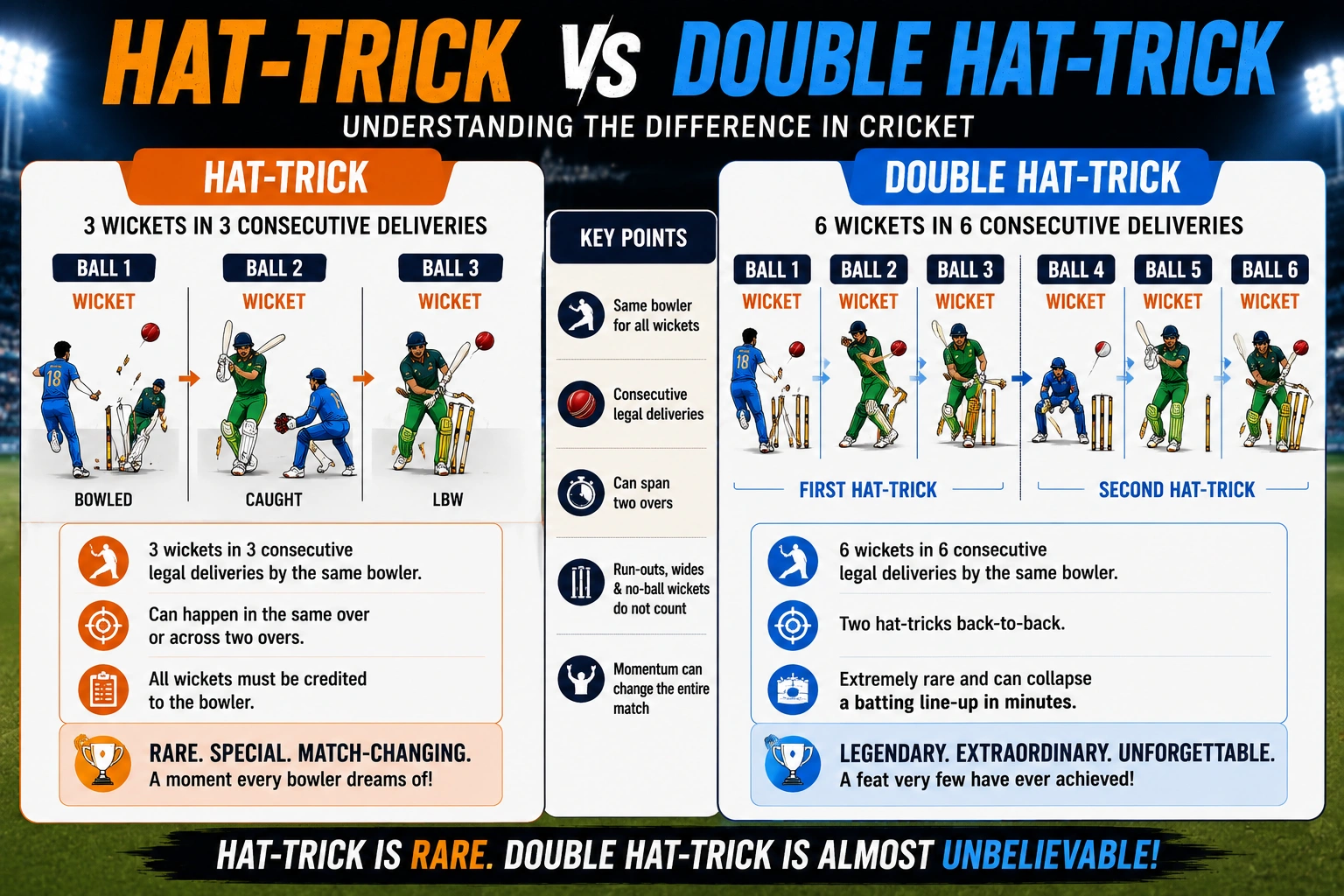
- A hat-trick means taking three wickets in three consecutive deliveries.
- A double hat-trick means taking six wickets in six consecutive deliveries.
- A double hat-trick is essentially two back-to-back hat-tricks.
- The same bowler must take all wickets in the sequence.
- The sequence can continue across two overs if the bowler bowls consecutive deliveries across those overs.
- Wasim Akram and Lasith Malinga share the record for the most international cricket hat-tricks, with four each.
- No officially recognized double hat-trick has been recorded in international cricket.
- Aled Carey and Gareth Morgan are among the best-known bowlers to take six wickets in six balls in club cricket.
What Is a Hat-Trick in Cricket?
A hat-trick in cricket occurs when a bowler dismisses three batters with three consecutive deliveries.
It sounds simple. In reality, it is brutally difficult.
The bowler must produce three wicket-taking balls in succession, without another bowler intervening and without the batting team escaping the pressure. A hat-trick may include dismissals such as bowled, caught, leg before wicket, stumped, or hit wicket, provided the wickets are credited to the bowler.
For example:
- Ball 1: Batter bowled.
- Ball 2: Batter caught at slip.
- Ball 3: Batter trapped LBW.
That is a hat-trick.
The term itself has a long association with cricket and became part of sporting vocabulary because the feat was considered special enough for a bowler to receive a hat as a prize in earlier eras of the game.
Hat-tricks can occur in Tests, One-Day Internationals, T20 Internationals, domestic cricket, franchise tournaments, first-class cricket, List A matches, and club cricket. ESPNcricinfo maintains dedicated record lists for hat-tricks in Test cricket, ODIs, and T20 Internationals.
What Is a Double Hat-Trick in Cricket?
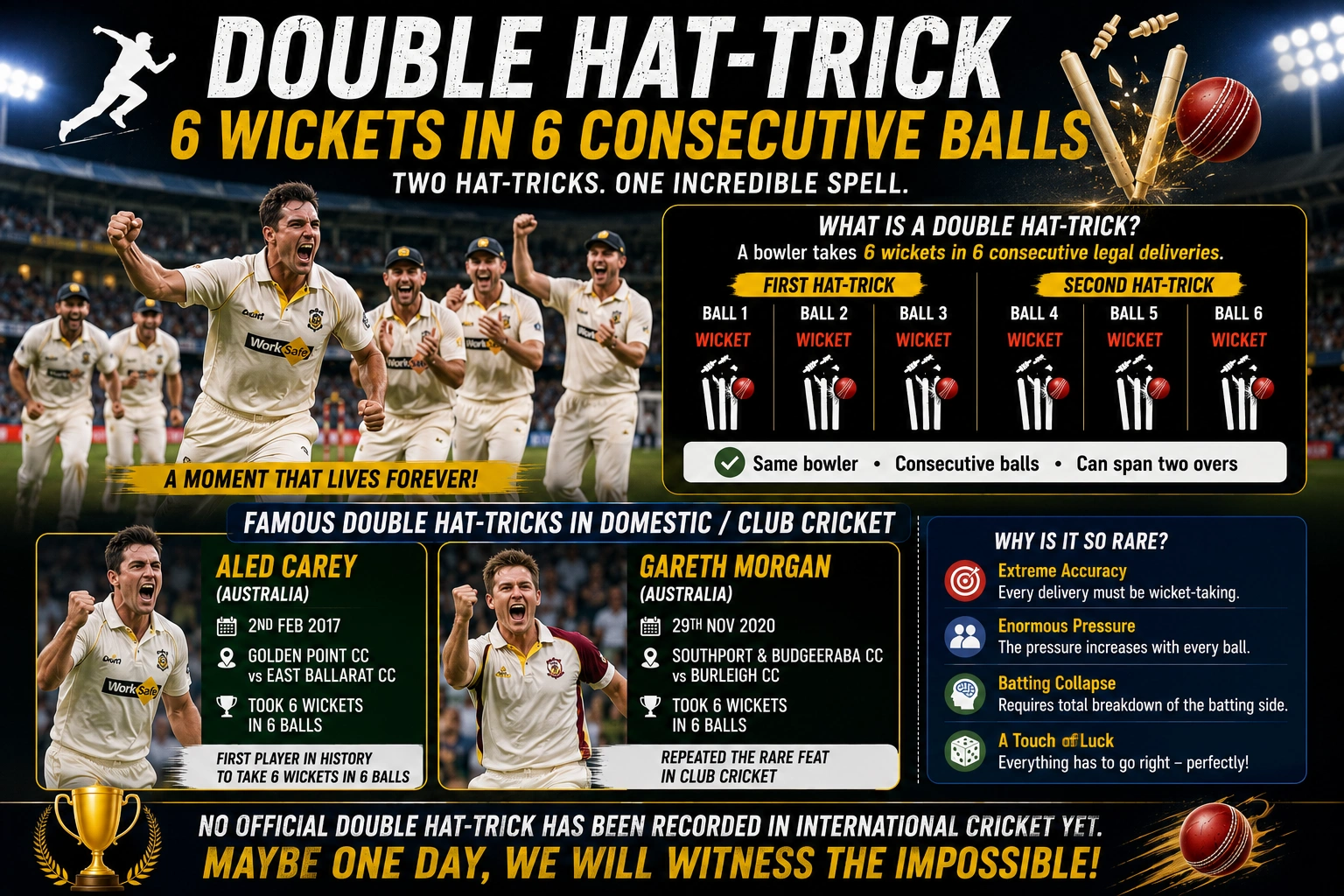
A double hat-trick means a bowler takes six wickets in six consecutive deliveries.
Put another way, it is two hat-tricks back-to-back.
| Bowling Achievement | Requirement |
| Hat-trick | 3 wickets in 3 consecutive balls |
| Four in four | 4 wickets in 4 consecutive balls |
| Five in five | 5 wickets in 5 consecutive balls |
| Double hat-trick | 6 wickets in 6 consecutive balls |
A regular hat-trick is rare enough to change the mood inside a stadium. A double hat-trick belongs in a different category altogether.
Imagine a batting side losing half of its wickets in just one over. That is not merely a collapse. It is chaos.
The phrase “double hat-trick” is widely used by cricket writers, broadcasters, fans, and statisticians. However, it is generally treated as an extraordinary extension of a hat-trick rather than a separate formal ICC statistical category.
Hat-Trick vs Double Hat-Trick in Cricket: Key Differences
The most obvious difference is the number of wickets, but the difficulty gap is even greater than the numbers suggest.
| Feature | Hat-Trick | Double Hat-Trick |
| Wickets required | 3 wickets | 6 wickets |
| Consecutive balls required | 3 balls | 6 balls |
| Difficulty level | Extremely rare | Almost unbelievable |
| Can span two overs? | Yes | Yes |
| International examples | Many | No officially recognized example |
| Match impact | Major momentum shift | Potentially match-defining collapse |
A bowler taking three wickets in three balls has already created huge pressure on the batting side. New batters are walking in with almost no time to settle. Fielders move closer. The captain becomes more aggressive. The stadium gets louder.
Now extend that pressure to six consecutive balls.
The result is usually devastating.
What Are the Complete Rules for a Hat-Trick?
A hat-trick is governed by straightforward cricket logic, although match situations can make the details interesting.
The Same Bowler Must Take All Three Wickets
The wickets must come from the same bowler’s consecutive deliveries.
If Bowler A takes two wickets and Bowler B takes the next wicket, it is not a hat-trick for either bowler.
The Wickets Must Come on Consecutive Deliveries
The three dismissals must happen on three successive balls delivered by the same bowler.
A hat-trick can occur within one over, but it can also stretch into another over.
For example:
- Last two balls of Over 18: Wicket, wicket.
- First ball of Over 20 by the same bowler: Wicket.
That still counts as a hat-trick because the bowler’s next delivery produced the third wicket.
The Hat-Trick Can Cross Overs
Yes, a hat-trick can span two overs.
This is one of the most common questions asked by cricket fans. The bowler may take wickets on the final deliveries of one over and then complete the hat-trick when returning for the next over.
The same concept applies to a double hat-trick. A bowler can take the last three wickets of one over and the first three wickets of the next over, provided the deliveries are consecutive for that bowler.
Run Outs Do Not Count as Bowling Hat-Trick Wickets
A wicket must be credited to the bowler for it to contribute to a hat-trick.
A run out is credited to the fielding side, not the bowler. Therefore, a run out does not count as one of the three wickets required for a bowling hat-trick.
No-Balls and Wides Need Careful Interpretation
No-balls and wides create extra deliveries. A bowler cannot claim a standard bowler-attributed dismissal such as bowled or LBW from a no-ball, while wides are not legal deliveries.
In practical cricket scoring terms, a hat-trick is based on wickets credited to the bowler from successive deliveries in the bowling sequence. Cricket’s laws distinguish between valid balls, no-balls, and wides, and these laws affect how deliveries are recorded in a scorecard.
Who Has Taken the Most Hat-Tricks in International Cricket?
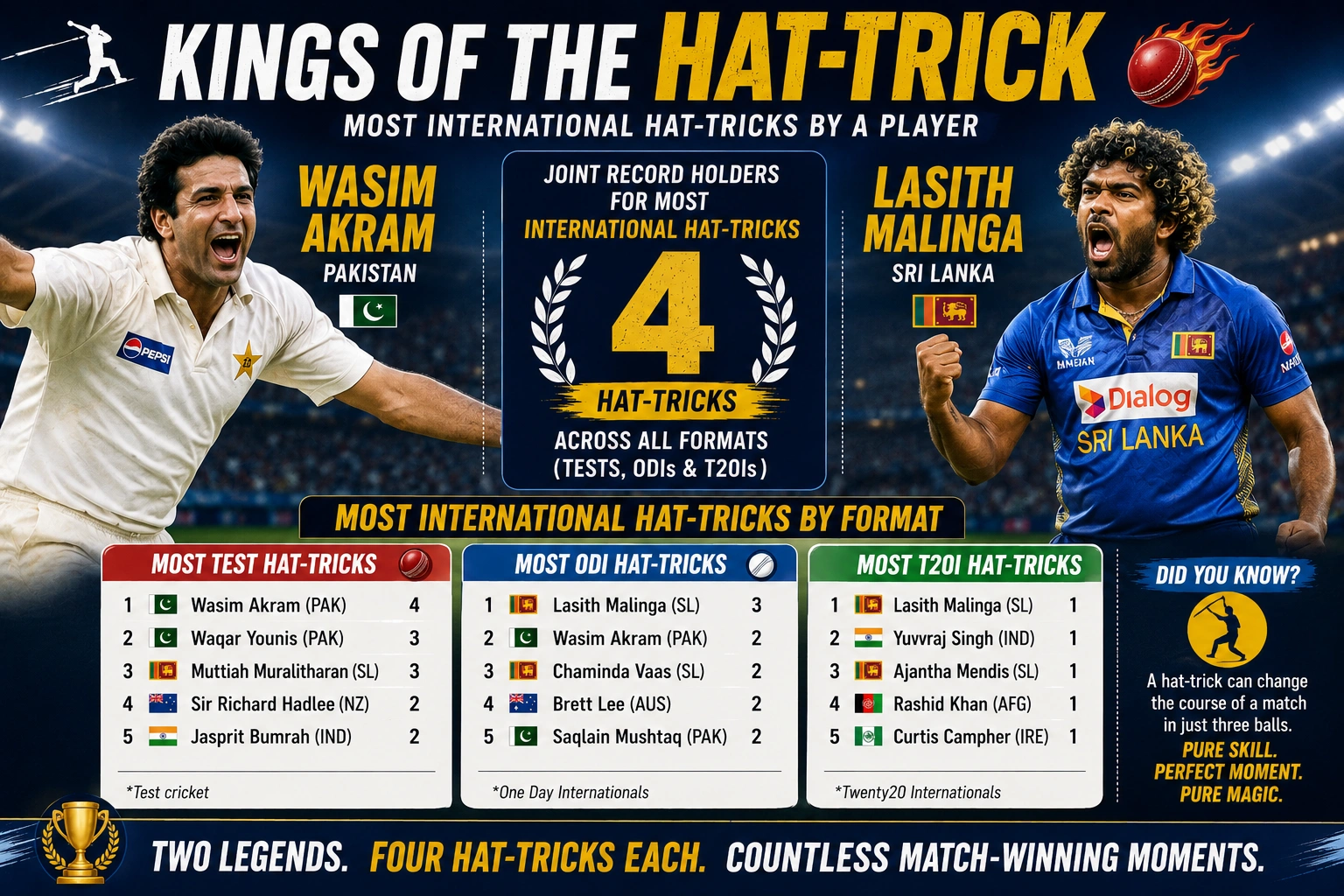
The record for the most international cricket hat-tricks is jointly held by Wasim Akram of Pakistan and Lasith Malinga of Sri Lanka, with four hat-tricks each. Guinness World Records lists both bowlers as joint holders of the international record.
Most International Hat-Tricks by Player
| Player | Country | International Hat-Tricks |
| Wasim Akram | Pakistan | 4 |
| Lasith Malinga | Sri Lanka | 4 |
Wasim Akram’s record reflects his extraordinary ability across formats. He was among cricket’s greatest left-arm fast bowlers and was capable of producing swing, seam movement, yorkers, and reverse swing under pressure.
Lasith Malinga, meanwhile, became one of the most feared white-ball bowlers in modern cricket. His unusual sling-arm action, toe-crushing yorkers, and exceptional death-over control made him a nightmare for lower-order batters.
Malinga’s most famous bowling burst came during the 2007 Cricket World Cup against South Africa, when he took four wickets in four balls. While that was not a double hat-trick, it remains one of the most dramatic sequences in ODI cricket history.
Most ODI Hat-Tricks
Lasith Malinga is widely recognized as the leading name in ODI hat-trick history, having taken three ODI hat-tricks. ESPNcricinfo’s ODI hat-trick records include performances from legends such as Wasim Akram, Kapil Dev, Brett Lee, Chaminda Vaas, Saqlain Mushtaq, Trent Boult, Kuldeep Yadav, and Malinga.
Hat-Tricks in Test Cricket
Test cricket has produced many memorable hat-tricks because the longer format allows bowlers to build pressure over spells and exploit changing pitch conditions.
From Fred Spofforth’s early Test-era brilliance to modern names such as Jasprit Bumrah, Test hat-tricks remain a rare mark of bowling excellence. ESPNcricinfo’s Test records archive tracks every recognized Test-match hat-trick.
Hat-Tricks in T20 Internationals
T20 Internationals create a different kind of pressure. Batters attack more often, which can create wicket opportunities, but bowlers have very little margin for error.
The T20I records list features hat-tricks from numerous international bowlers, reflecting how quickly a match can turn in cricket’s shortest format.
Famous Double Hat-Tricks in Domestic and Club Cricket
No bowler has recorded an officially recognized double hat-trick in international cricket. However, cricket outside the international arena has produced a few astonishing six-wickets-in-six-balls performances.
Aled Carey: Six Wickets in Six Balls
Australian club cricketer Aled Carey became widely known after taking six wickets in six balls for Golden Point Cricket Club against East Ballarat Cricket Club.
Guinness World Records recognizes Carey as the first cricketer to take six wickets in a six-ball over. It was a stunning club-cricket moment and one of the clearest examples of what fans describe as a double hat-trick.
Gareth Morgan: Another Six-Ball, Six-Wicket Feat
Australian cricketer Gareth Morgan later matched the extraordinary feat by taking six wickets in six balls during a third-grade cricket match on the Gold Coast.
His performance proved that, while incredibly rare, cricket can still deliver moments that sound impossible until the scorecard confirms them.
Why These Performances Matter
Club and domestic cricket may not receive the same global attention as international cricket, but these records deserve genuine respect.
Taking six wickets in six balls requires more than luck. The bowler needs control, accuracy, tactical awareness, confident fielding support, and the ability to remain calm while the pressure builds with every delivery.
Why Has No Double Hat-Trick Happened in International Cricket?
International batting line-ups are deeper, more experienced, and technically stronger than most club-level teams.
Even when a bowler takes three wickets in a row, the incoming batter is usually capable of surviving, defending, leaving well, or simply finding a way to break the sequence.
There is also the pressure factor. After three or four consecutive wickets, every player on the ground knows something historic may be happening. The bowler feels it. The captain feels it. The new batter definitely feels it.
One slightly overpitched ball, one dropped catch, one edged boundary, or one defensive block can end the sequence.
That is why a double hat-trick is not merely rare. It is close to cricketing fantasy.
FAQs
What is the difference between a hat-trick and a double hat-trick in cricket?
A hat-trick means a bowler takes three wickets in three consecutive deliveries. A double hat-trick means six wickets in six consecutive deliveries, effectively creating two back-to-back hat-tricks in one bowling sequence.
Can a hat-trick happen across two overs?
Yes. A bowler can take wickets on the final deliveries of one over and complete the hat-trick on the first ball of their next over. The wickets must remain consecutive in that bowler’s delivery sequence.
Has anyone taken a double hat-trick in international cricket?
No officially recognized double hat-trick has been recorded in international cricket. However, Australian club cricketers Aled Carey and Gareth Morgan have famously taken six wickets in six balls in club-level matches.
Who has the most hat-tricks in international cricket history?
Wasim Akram of Pakistan and Lasith Malinga of Sri Lanka jointly hold the record for the most international hat-tricks, with four each.
Conclusion
A hat-trick is one of cricket’s great adrenaline moments. Three balls, three wickets, and suddenly the match feels different. A double hat-trick takes that drama to another level by demanding six wickets in six consecutive deliveries.
International cricket has given fans countless hat-tricks, including iconic performances from Wasim Akram and Lasith Malinga. But a true double hat-trick at international level remains missing from the record books.
For now, it remains one of cricket’s ultimate “what if” moments—and perhaps one of the few records that still feels almost impossible.