How Many Wickets Constitute a Double Hat-Trick? Complete Cricket Guide


Picture this. A bowler removes three batters with three consecutive deliveries, and the stadium erupts. That’s already one of cricket’s rarest moments. But what if the same bowler keeps striking and dismisses six batters in six consecutive legal deliveries? At that point, you’re witnessing something almost mythical—a double hat-trick. It’s so uncommon that even many lifelong cricket fans have never seen one live.
Let’s break down exactly what a double hat-trick means, how it differs from a regular hat-trick, which bowlers have achieved it, and why it can completely change the course of a cricket match.
Quick Summary
- A double hat-trick means six wickets in six consecutive legal deliveries by the same bowler.
- It is effectively two consecutive hat-tricks.
- The deliveries may span two overs if no other bowler delivers in between.
- It is far rarer than a standard hat-trick.
- Only a handful of bowlers in professional cricket have achieved this extraordinary feat.
- A double hat-trick often changes the momentum of a match within minutes.
-
Understanding how a double hat-trick works in cricket.
What Is a Double Hat-Trick in Cricket?
A regular hat-trick occurs when a bowler dismisses three batters with three consecutive legal deliveries.
A double hat-trick extends this remarkable sequence. The bowler must take:
Six wickets with six consecutive legal balls.
Every dismissal has to come from legal deliveries. Wickets from no-balls don’t count because they aren’t legal balls, while wickets on wides are generally not counted since wides are illegal deliveries. The sequence can continue across overs as long as the same bowler bowls the consecutive legal deliveries.
For example:
- Last three balls of one over: Wicket, Wicket, Wicket
- First three balls of the next over by the same bowler: Wicket, Wicket, Wicket
That still qualifies as a double hat-trick because the six wickets came from six consecutive legal deliveries.

How Does a Double Hat-Trick Differ from Other Bowling Feats?
Cricket has several remarkable bowling milestones, and they are often confused.
| Achievement | Requirement |
| Hat-trick | 3 wickets in 3 consecutive legal balls |
| Four in Four | 4 wickets in 4 consecutive legal balls |
| Five in Five | 5 wickets in 5 consecutive legal balls |
| Double Hat-Trick | 6 wickets in 6 consecutive legal balls |
Many bowlers have claimed hat-tricks over the years. Four-in-four remains exceptionally rare. Six consecutive wickets is in an entirely different category because it requires flawless accuracy, sustained pressure, and often a bit of fortune.
Is a Double Hat-Trick Officially Recognized?
Interestingly, the term double hat-trick is widely used by cricket fans, commentators, and statisticians, but it is not an official ICC statistical category.
The ICC officially records:
- Hat-tricks
- Bowling figures
- Match records
- Individual wickets
A double hat-trick is generally recognized as an exceptional extension of the traditional hat-trick rather than a separate official record category.
That doesn’t make the achievement any less extraordinary. If anything, its rarity makes it one of cricket’s most fascinating unofficial milestones.
Players Who Have Achieved a Double Hat-Trick
Since six wickets in six balls is extraordinarily difficult, only a very small number of bowlers have managed it in recognized cricket.
Aled Carey (Australia)
One of the most widely recognized double hat-tricks came from Australian fast bowler Aled Carey during a domestic T20 match in 2017.
His remarkable spell included:
- Six wickets in six consecutive legal balls
- Two separate hat-tricks achieved back-to-back
- Bowling figures that instantly entered cricket history
The feat became global news because even many international bowlers have never come close to such a sequence.
Gareth Morgan (England)
English club cricketer Gareth Morgan is another bowler credited with taking six wickets in six consecutive deliveries during club cricket.
Although achieved below international level, it remains one of cricket’s most astonishing bowling performances.
Other Reported Cases
Across club cricket, school competitions, domestic tournaments, and age-group cricket, several bowlers have reportedly claimed six wickets in six balls.
However, these performances vary depending on:
- Match status
- Competition level
- Official statistical recognition
Because of these differences, cricket historians often distinguish between international, first-class, List A, T20, and club-level achievements.
Why Is a Double Hat-Trick So Rare?
Taking six consecutive wickets requires far more than bowling well.
Several factors must align perfectly.
Outstanding Accuracy
Every delivery must consistently challenge the batter.
One loose ball can break the sequence instantly.
New Batter Pressure
Incoming batters often need a few deliveries to settle.
A bowler on a hot streak can exploit that uncertainty.
Field Placement
Captains usually attack with aggressive catching positions once multiple wickets fall.
Close fielders create extra dismissal opportunities.
Mental Pressure
After three or four consecutive wickets, the entire stadium becomes aware of history.
Both the batting side and bowler experience enormous psychological pressure.
Maintaining composure becomes just as important as bowling skill.
Can a Double Hat-Trick Span Two Overs?
Yes.
This is one of the most commonly searched questions.
A double hat-trick does not have to occur within a single over.
For example:
- Over 18: Last three balls produce wickets.
- Over 20: Same bowler returns and takes the first three wickets.
Since no other delivery by that bowler interrupted the sequence of legal balls, it still counts.
The same principle applies to a regular hat-trick.
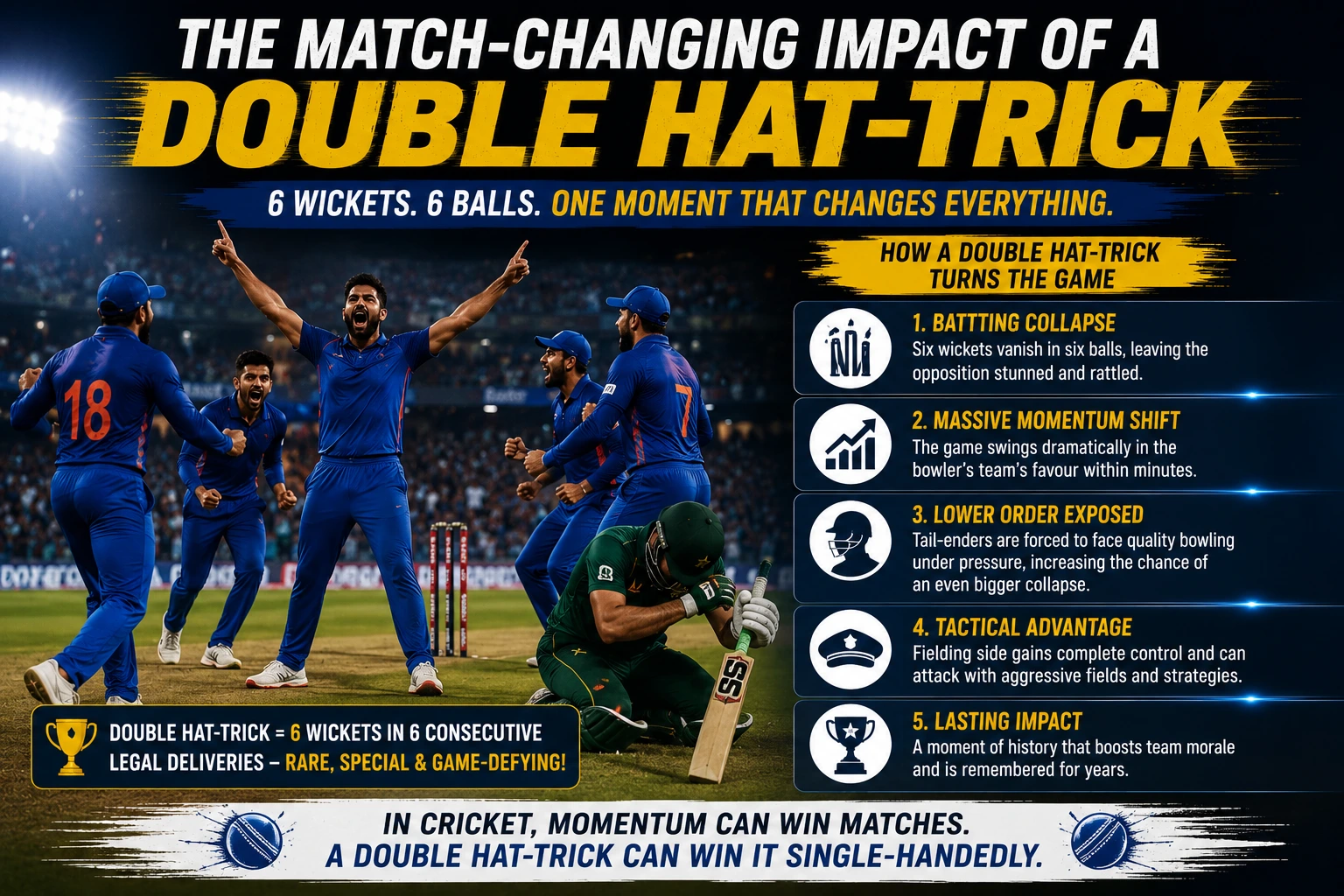
What Impact Does a Double Hat-Trick Have on a Match?
A double hat-trick almost always changes the direction of the game.
Batting Collapse
Six wickets disappear within six deliveries.
Even strong batting line-ups struggle to recover from such devastation.
Massive Momentum Shift
Cricket is often decided by momentum.
One extraordinary spell can transform a winning position into a losing one within minutes.
Lower-Order Exposure
When six wickets fall rapidly, lower-order batters are forced to face the opposition much earlier than planned.
That usually increases the chances of an even quicker collapse.
Captain’s Tactical Advantage
Captains can immediately switch to attacking fields because confidence is high and the batting side is under pressure.
Slip fielders, short leg, silly point, and close-catching positions become more effective.
Long-Term Career Recognition
Even if a player never reaches international cricket, a double hat-trick often becomes the defining achievement of their career.
It earns lasting recognition among teammates, fans, and cricket historians.
Could We See One in International Cricket?
It’s certainly possible, but history suggests it will remain extremely rare.
International batters are technically stronger than domestic players and usually prevent prolonged collapses.
Still, cricket has produced countless moments once thought impossible.
We’ve witnessed:
- Double centuries in ODIs
- 400-run Test innings
- Super Overs deciding World Cups
- Bowlers taking all ten wickets in an innings
So a double hat-trick on the international stage may simply be a matter of time.
Why Cricket Fans Love These Rare Records
Part of cricket’s charm lies in its statistical richness.
Fans celebrate:
- Hat-tricks
- Perfect spells
- Triple centuries
- Ten-wicket innings
- Record partnerships
A double hat-trick combines skill, pressure, and history into six unforgettable deliveries.
It’s the kind of moment that gets replayed for years and becomes part of cricket folklore.
Frequently Asked Questions
How many wickets are needed for a double hat-trick?
A double hat-trick requires six wickets in six consecutive legal deliveries by the same bowler. It is essentially two back-to-back hat-tricks.
Can a double hat-trick happen across two overs?
Yes. As long as the six wickets come from six consecutive legal deliveries by the same bowler, the sequence may continue into another over.
Has anyone taken a double hat-trick in international cricket?
As of now, no officially recognized international cricketer has recorded six wickets in six consecutive legal balls in an international match. Most documented double hat-tricks have occurred in domestic or club cricket.
Is a double hat-trick an official ICC record?
No. The ICC officially recognizes hat-tricks but does not maintain a separate statistical category for double hat-tricks. The term is widely accepted by commentators, statisticians, and cricket enthusiasts.
Conclusion
A double hat-trick sits among cricket’s rarest bowling accomplishments. Taking six wickets in six consecutive legal deliveries demands exceptional accuracy, relentless pressure, and perfect execution. While the ICC doesn’t officially classify it as a separate record, its significance is unquestionable. Every time a bowler comes close, fans pause to watch history unfold. Whether it happens in club cricket or eventually on the international stage, a double hat-trick remains one of the sport’s most astonishing feats.