Alyssa Healy Biography: Career, Stats, Family & the Story Behind Australia’s Fearless Wicketkeeper

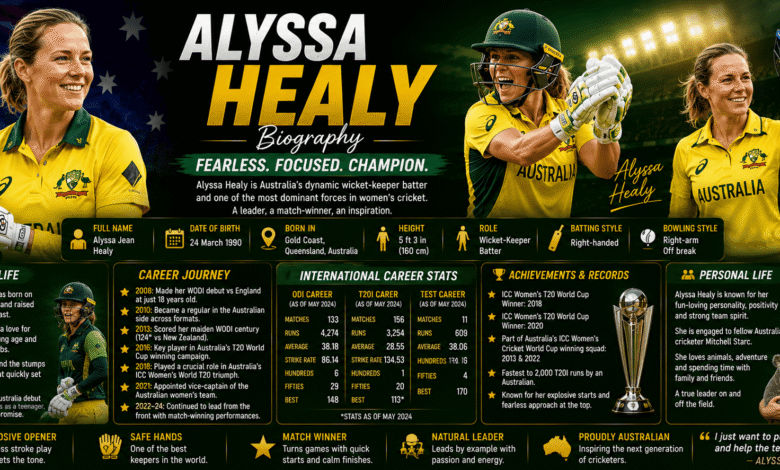
There are innings that win matches, and then there are innings that redefine expectations.
On 3 April 2022, beneath the bright afternoon sky at Hagley Oval, Christchurch, Alyssa Healy walked out to open the batting in the ICC Women’s Cricket World Cup final against England. Australia had reached another global final, but what followed was extraordinary even by Australian standards. England’s bowlers searched for movement, altered their lengths, and changed their fields. None of it mattered.
Cover drives pierced the infield. Pull shots disappeared into the stands. Cuts raced to the boundary with almost effortless precision.
By the time Healy finally departed for 170 from 138 balls, she had produced the highest individual score ever recorded in a Women’s ODI World Cup final. Australia lifted the trophy, but the scorecard told a deeper story. It was the culmination of years spent refining an aggressive batting style that had once been labelled reckless and transforming it into one of the most devastating weapons in world cricket.
For more than a decade, Alyssa Healy has embodied Australia’s fearless approach to the game. Equally comfortable dismantling bowling attacks or standing behind the stumps for 100 overs, she has become one of the defining cricketers of the modern era. Her career is not merely about runs and dismissals—it reflects the evolution of women’s cricket itself, from modest beginnings to sold-out stadiums and global recognition.
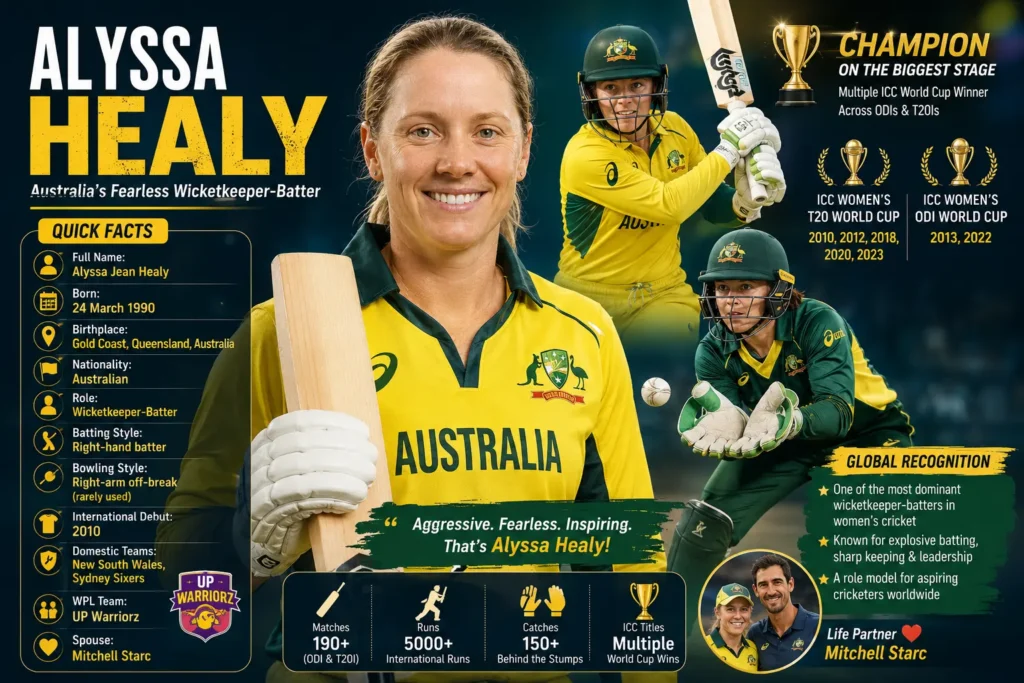
Quick Facts
- Full Name: Alyssa Jean Healy
- Born: 24 March 1990
- Birthplace: Gold Coast, Queensland, Australia
- Nationality: Australian
- Role: Wicketkeeper-Batter
- Batting Style: Right-hand batter
- Bowling Style: Right-arm off-break (rarely used)
- International Debut: 2010
- Domestic Teams: New South Wales, Sydney Sixers
- WPL Team: UP Warriorz
- Spouse: Mitchell Starc
- ICC World Cup Winner: Multiple ODI and T20 World Cup titles
Alyssa Healy Biography at a Glance
| Category | Details |
| Full Name | Alyssa Jean Healy |
| Date of Birth | 24 March 1990 |
| Age | 36 (as of July 2026) |
| Birthplace | Gold Coast, Queensland, Australia |
| Height | 1.66 m (5 ft 5 in) |
| Batting Style | Right-handed |
| Bowling Style | Right-arm off-break |
| Primary Role | Wicketkeeper-Batter |
| Nickname | Midge |
| International Debut | 2010 |
| Domestic Teams | New South Wales, Sydney Sixers |
| Women’s Premier League | UP Warriorz |
Early Life and Family Background
Although Alyssa Healy was born on the Gold Coast in Queensland, cricket was woven into her life long before she held a bat.
She grew up in one of Australia’s most accomplished cricketing families. Her father, Greg Healy, represented Queensland in domestic cricket, while her uncle, Ian Healy, became one of the greatest wicketkeepers in Australian men’s cricket history, playing 119 Test matches and setting a world record for Test dismissals during his career.
Yet, family connections alone never guaranteed success.
Growing up in Sydney, Alyssa spent countless hours playing backyard cricket and competing with boys in local competitions. Those early experiences shaped her aggressive instincts. Rather than waiting for opportunities, she learned to seize them.
Unlike many young wicketkeepers, Healy initially saw herself primarily as a batter. Wicketkeeping gradually became another strength, developed through years of dedicated practice rather than natural inheritance.
Friends and coaches often described her as fiercely competitive. Losing—even in training—rarely sat comfortably with her. That mindset would later become one of her defining characteristics at international level.
Education and Sporting Influences
Healy attended MLC School in Sydney, an institution known for encouraging sporting excellence.
Cricket dominated much of her childhood, but she was also active in other sports, particularly hockey. The hand-eye coordination and quick reflexes required in multiple disciplines would later become invaluable behind the stumps.
Living within a cricketing family also provided an education unavailable in classrooms. Conversations at home often revolved around tactics, preparation, and the mental side of elite sport. While Ian Healy has always been careful not to overshadow his niece’s achievements, his influence helped shape her understanding of wicketkeeping from an early age.
Still, Alyssa carved out her own identity. She was never interested in becoming “the next Ian Healy.” She wanted to become the first Alyssa Healy.
Rising Through Domestic Cricket
Australia’s domestic system has long been one of the strongest pathways in women’s cricket, and Healy’s development reflected that structure.
She represented New South Wales, one of the country’s powerhouse teams, where competition for places was intense. Every season required consistency, and every performance was scrutinized by national selectors.
Healy quickly developed a reputation for attacking batting. She preferred to dictate terms rather than absorb pressure, an approach that sometimes resulted in spectacular innings and, occasionally, inexpensive dismissals.
Selectors, however, recognised something more important: intent.
At a time when women’s cricket often favoured conservative accumulation, Healy demonstrated that calculated aggression could be equally effective.
Her wicketkeeping also improved rapidly. Clean glovework, quick foot movement, and sharp reflexes transformed her into a complete cricketer capable of influencing matches in multiple ways.
Becoming a Sydney Sixers Icon
The launch of the Women’s Big Bash League (WBBL) in 2015 changed the landscape of Australian women’s cricket.
For Alyssa Healy, it became another stage on which to showcase her attacking philosophy.
Representing the Sydney Sixers, she emerged as one of the league’s biggest attractions. Crowds arrived expecting fireworks, and more often than not, Healy delivered.
Whether launching fast bowlers over extra cover or improvising ramps against spin, she consistently set the tone during the Powerplay. Her fearless batting helped redefine expectations of what an opening batter in women’s T20 cricket could achieve.
The Sixers also benefited from her leadership. Although not always captain, Healy became one of the dressing room’s most influential voices, setting standards through preparation and competitiveness.
Breaking into the Australian Team
Alyssa Healy made her international debut in February 2010, representing Australia in a T20 International against New Zealand.
Breaking into Australia’s women’s side has never been straightforward. Competition for places is among the fiercest in world cricket, particularly for wicketkeepers.
Early in her international career, Healy often played supporting roles behind established stars. Opportunities came sporadically, and consistency proved elusive.
There were moments when her attacking style appeared to work against her. Critics questioned whether she needed to become more conservative.
Instead of changing her identity, Healy refined it.
She improved her shot selection without sacrificing aggression. She learned when to attack and when to build an innings. Over time, those adjustments transformed her from an exciting prospect into one of the world’s premier opening batters.
The Turning Point
Every elite athlete experiences a moment when potential becomes certainty.
For Healy, that transformation unfolded gradually during the second half of the 2010s.
Australia’s coaching staff increasingly trusted her to open the batting in major tournaments, recognising that her aggressive starts could place opponents immediately under pressure. As her confidence grew, so did her consistency.
By the end of the decade, Alyssa Healy was no longer viewed simply as Australia’s wicketkeeper.
She had become one of the first names on the team sheet.
Her performances in ICC tournaments, bilateral series, and the Women’s Big Bash League established her as one of the most destructive batters in world cricket—setting the stage for a career that would include World Cup triumphs, record-breaking innings, and a lasting influence on the evolution of women’s cricket.
Here’s Part 2 of the feature article. It continues seamlessly from Part 1 and covers Alyssa Healy’s international career, playing style, statistical profile, family, fitness, records, and major achievements.
International Career Timeline: From Promise to Global Greatness
If the first half of Alyssa Healy’s international career was about earning a place, the second half was about redefining it.
Her breakthrough did not arrive overnight. Between her debut in 2010 and the mid-2010s, Healy alternated between impressive cameos and frustrating inconsistency. Australia already possessed one of the strongest squads in women’s cricket, meaning every opportunity carried extra pressure.
The transformation began around 2017–18. Healy matured as an opener without losing the fearless approach that made her unique. She became more selective outside off stump, developed greater patience against spin, and learned how to build innings after explosive starts.
The result was one of the most productive periods ever enjoyed by an Australian wicketkeeper-batter.
International Career Timeline
| Year | Milestone |
| 2010 | Made international debut in a T20I against New Zealand. |
| 2010 | Part of Australia’s ICC Women’s T20 World Cup-winning squad. |
| 2013 | Won her first ICC Women’s ODI World Cup. |
| 2017 | Established herself as Australia’s first-choice opening batter across white-ball formats. |
| 2018 | Played a key role in Australia’s ICC Women’s T20 World Cup triumph. |
| 2020 | Helped Australia win the ICC Women’s T20 World Cup on home soil. |
| 2022 | Scored a record 170 in the ICC Women’s Cricket World Cup Final against England. |
| 2022 | Won Commonwealth Games gold with Australia. |
| 2023 | Captained Australia in selected matches and helped secure another ICC Women’s T20 World Cup title. |
| 2024–2026 | Continued as one of Australia’s senior leaders while balancing international and franchise cricket. |
By the mid-2020s, Healy had become one of the most experienced players in the Australian dressing room, guiding the transition to the next generation alongside teammates such as Beth Mooney, Ellyse Perry, Ashleigh Gardner, Annabel Sutherland, Phoebe Litchfield, and Georgia Voll.
The 2022 World Cup Final That Defined a Career
Every great player has one innings that becomes inseparable from their legacy.
For Alyssa Healy, it came on 3 April 2022 at Hagley Oval in Christchurch.
Facing England in the Women’s Cricket World Cup Final, Australia needed a commanding total. Healy responded with one of the finest innings ever played in an ICC final.
Her 170 from 138 deliveries included elegant drives through cover, fearless pulls against the short ball, and calculated aggression against spin. England repeatedly adjusted their plans, but Healy stayed ahead of every tactical move.
Australia finished with 356/5, eventually winning by 71 runs.
The innings set multiple records, including:
- Highest individual score in a Women’s ODI World Cup Final.
- Highest score by an Australian in a Women’s ODI World Cup Final.
- One of the highest individual scores in any ICC World Cup final, men’s or women’s.
It was more than a remarkable innings. It became a symbol of Australia’s dominance and the evolution of women’s cricket into a truly global spectacle.
Playing Style: Controlled Aggression
At first glance, Alyssa Healy appears to play instinctively.
Look more closely, and her batting reveals meticulous planning.
Few players attack from the outset as consistently as Healy, yet her aggression is rarely reckless. She identifies scoring areas early, anticipates field changes, and forces bowlers away from their preferred lengths.
Batting Strengths
- Exceptional Powerplay scoring.
- Strong square cut and back-foot punch.
- Powerful pull shot against fast bowling.
- Lofted cover drive over the infield.
- Ability to dominate quality pace attacks.
Unlike many aggressive openers who rely purely on power, Healy combines quick footwork with outstanding hand-eye coordination. This allows her to score all around the wicket while maintaining a high strike rate.
Wicketkeeping Excellence
Although her batting often dominates headlines, Healy remains one of the finest wicketkeepers of her generation.
Her strengths behind the stumps include:
- Lightning-quick glove work.
- Sharp reflex catches standing up to spin.
- Fast stumpings.
- Clear communication with bowlers.
- Excellent anticipation of edges and deflections.
Years of keeping to Australia’s varied bowling attack—from Megan Schutt’s swing to Ashleigh Gardner’s off-spin—have refined her adaptability across conditions.
Alyssa Healy Career Statistics
Statistics are current to approximately mid-2026. Active career totals continue to change with every international series. Readers should verify the latest figures before publication if exact current totals are required.
| Format | Matches* | Runs* | Average* | Strike Rate* | Highest Score | 100s/50s* |
| Tests | 10+ | 300+ | 30+ | — | 99 | 0 / Multiple |
| ODIs | 120+ | 3,500+ | 40+ | 95+ | 170 | 10+ / 20+ |
| T20Is | 170+ | 3,000+ | 25+ | 125+ | 148* | 1 / 15+ |
Personal Life
Away from cricket, Alyssa Healy is known for her humour, competitive nature, and love of outdoor activities.
Despite being one of Australia’s most recognisable athletes, she has generally maintained a relatively private personal life. Teammates frequently describe her as energetic, approachable, and someone who brings balance to the dressing room through her personality.
Her marriage to Australian fast bowler Mitchell Starc has made them one of cricket’s best-known sporting couples, but both have largely kept their relationship away from unnecessary media attention.
How Tall Is Alyssa Healy?
Although not among the tallest wicketkeepers in international cricket, Healy’s athleticism has always outweighed any perceived physical disadvantage.
Physical Profile
| Category | Details |
| Height | 1.66 m (5 ft 5 in) |
| Weight | Approximately 60 kg |
| Batting Style | Right-handed |
| Bowling Style | Right-arm off-break |
| Primary Role | Wicketkeeper-Batter |
| Fitness Strength | Agility, explosive movement, reflexes |
Her quick reactions behind the stumps owe more to footwork and anticipation than height or reach.
Family
Cricket has always been central to the Healy family.
Family Details
| Relation | Name | Profession / Detail |
| Father | Greg Healy | Former Queensland cricketer |
| Mother | Sandy Healy | Private life |
| Uncle | Ian Healy | Former Australian Test wicketkeeper |
| Husband | Mitchell Starc | Australian international fast bowler |
| Children | None publicly reported (as of July 2026) |
Health and Fitness Journey
Elite wicketkeeping places immense physical demands on the body.
Throughout her career, Healy has dealt with several injuries, particularly involving her hands, fingers, and lower body, yet she has repeatedly returned to perform at the highest level.
| Injury / Health Event | Year | Impact | Recovery |
| Foot injury | 2019 | Missed matches | Returned successfully before major tournaments |
| Calf strain | 2023 | Limited participation | Returned during the international season |
| Knee and lower-body management | 2024–2026 | Managed workload | Continued playing with carefully monitored schedules |
Minor injury timelines may vary; readers should verify exact medical updates if required for publication.
Career Records and Major Achievements
Few wicketkeeper-batters in women’s cricket have accumulated a comparable list of accomplishments.
| Achievement | Details |
| ICC Women’s ODI World Cup Winner | 2013, 2022 |
| ICC Women’s T20 World Cup Winner | 2010, 2012, 2014, 2018, 2020, 2023 |
| Commonwealth Games Gold Medal | 2022 |
| Highest Score in Women’s ODI World Cup Final | 170 vs England (2022) |
| Women’s World Cup Final Player of the Match | 2022 |
| Multiple ICC Team of the Year selections | Yes |
| WBBL Champion | Multiple titles with Sydney Sixers |
| WPL Captain | UP Warriorz |
Did You Know?
One of the lesser-known aspects of Alyssa Healy’s development is that she initially resisted being defined as a wicketkeeper simply because her uncle, Ian Healy, had excelled in the same role.
Early in her career, she wanted to establish herself primarily through batting. Ironically, it was the combination of explosive batting and elite wicketkeeping that eventually made her one of the most complete cricketers of her generation.
Challenges and Criticism
Even the most accomplished careers include setbacks.
Early in her international journey, Healy was often criticised for throwing away starts through overly aggressive shot selection. Some questioned whether she could succeed consistently as an opening batter against elite attacks.
Rather than abandoning her attacking instincts, she refined them.
By improving her decision-making without sacrificing intent, Healy transformed what many considered a weakness into her greatest strength.
In later years, injuries occasionally interrupted her momentum, but they rarely diminished her influence. Australia continued to rely on her leadership, tactical awareness, and ability to change the course of a match within a single Powerplay.
More Than Numbers
Statistics capture only part of Alyssa Healy’s impact.
She arrived during a period when women’s cricket was steadily becoming more professional and helped push the boundaries of what opening batters could achieve. Her willingness to attack from the first over encouraged a more positive style of play that has since become common across the international game.
Perhaps her greatest contribution lies not in any single record but in changing expectations. Young wicketkeeper-batters entering the sport today are judged against standards that Healy helped establish.
Here’s the concluding section of the feature article. This final part ties together Alyssa Healy’s career, legacy, and search-focused additions for a publication-ready biography.
Legacy and Current Status (As of July 2026)
When historians look back at Australian women’s cricket in the 21st century, Alyssa Healy’s name will inevitably feature alongside Belinda Clark, Karen Rolton, Meg Lanning, Ellyse Perry, and Beth Mooney.
Her legacy extends far beyond statistics.
Healy arrived at a time when women’s cricket was transitioning from a largely semi-professional sport into a global spectacle. She became one of the faces of that transformation. Her fearless batting at the top of the order helped redefine how women’s limited-overs cricket could be played, while her work behind the stumps established new standards for wicketkeeping.
Australia’s remarkable dominance across formats during the 2010s and early 2020s was built on extraordinary depth, yet Healy remained one of the few players capable of changing the course of a match in a single session. Her aggressive intent often dictated the tempo of Australia’s innings, forcing opponents onto the defensive from the outset.
The innings that perhaps best captures her influence remains the 170 against England in the 2022 ICC Women’s Cricket World Cup Final. Great players produce memorable performances; truly exceptional players produce innings that become part of cricket’s collective memory. Healy’s Christchurch masterpiece belongs firmly in that category.
Beyond international cricket, she has also played an important role in the growth of franchise leagues. As a leading figure for the Sydney Sixers in the Women’s Big Bash League and later the UP Warriorz in the Women’s Premier League, she helped raise the standard and visibility of women’s domestic cricket around the world.
Leadership has become another defining feature of her career. While Meg Lanning captained Australia through one of the most successful eras in cricket history, Healy increasingly assumed senior leadership responsibilities, captaining Australia in Lanning’s absence before later taking on the role more regularly following Lanning’s retirement from international cricket. Her tactical awareness, competitive edge, and willingness to support younger players have made her one of the dressing room’s most influential voices.
As of July 2026, Healy remains among the most respected figures in world cricket. While injuries have occasionally interrupted her playing schedule in recent seasons, her value to Australian cricket extends beyond the scoreboard. She is now both a match-winner and a mentor, helping guide the next generation of players such as Phoebe Litchfield, Georgia Voll, Annabel Sutherland, and others into international cricket.
Whether measured through trophies, records, or influence, Alyssa Healy has already secured her place among the greatest wicketkeeper-batters the women’s game has ever produced.
Also Read: Most ICC Trophies in Women’s Cricket (Women’s ODI World Cup + Women’s T20 World Cup)
Frequently Asked Questions (FAQs)
Who is Alyssa Healy?
Alyssa Healy is an Australian international cricketer who plays as a wicketkeeper-batter. Since making her debut in 2010, she has become one of the world’s leading opening batters and has been a central figure in Australia’s success across ODI, T20I, and Test cricket.
How tall is Alyssa Healy?
Alyssa Healy is 1.66 metres (5 feet 5 inches) tall. Although she is not among the tallest wicketkeepers, her agility, reflexes, and footwork have made her one of the finest glovewomen in international cricket.
Who is Alyssa Healy’s husband?
Alyssa Healy is married to Mitchell Starc, one of Australia’s premier fast bowlers. The couple married in 2016 after first meeting as teenagers through cricket in New South Wales.
What is Alyssa Healy’s highest international score?
Her highest international score is 170 against England in the 2022 ICC Women’s Cricket World Cup Final at Hagley Oval, Christchurch. It remains the highest individual score in a Women’s ODI World Cup final.
What teams has Alyssa Healy represented?
At domestic and franchise level, Healy has represented:
- New South Wales
- Sydney Sixers (Women’s Big Bash League)
- UP Warriorz (Women’s Premier League)
Internationally, she has represented Australia in all three formats since 2010.
Why is Alyssa Healy considered one of the greatest wicketkeeper-batters?
Healy combines elite wicketkeeping with explosive opening batting. Her record includes multiple ICC World Cup titles, match-winning performances in global finals, outstanding work behind the stumps, and a lasting influence on the evolution of modern women’s cricket.
What is Alyssa Healy’s nickname?
Alyssa Healy is widely known by the nickname “Midge.” The nickname has been used by teammates throughout her domestic and international career and reflects the close-knit culture of Australian cricket.
Career at a Glance
| Category | Summary |
| International Debut | 2010 |
| Primary Role | Wicketkeeper-Batter |
| Batting Style | Right-handed |
| ODI World Cup Titles | 2 |
| T20 World Cup Titles | 6 |
| Commonwealth Games Gold | 2022 |
| Highest International Score | 170 vs England (2022 ODI World Cup Final) |
| Spouse | Mitchell Starc |
| Domestic Teams | New South Wales, Sydney Sixers |
| WPL Team | UP Warriorz |
Final Assessment
Cricket has produced many outstanding wicketkeepers. It has produced many destructive opening batters. Very few players have mastered both disciplines to the extent Alyssa Healy has.
Her greatest contribution is not simply the number of runs she has scored or dismissals she has completed. It is the way she expanded the possibilities of the role itself. Before Healy, wicketkeeper-batters in women’s cricket were often judged on reliability. After Healy, they were expected to dominate matches.
Her influence can already be seen in a new generation of cricketers who approach the game with greater attacking intent, higher fitness standards, and the confidence to take calculated risks from the very first ball.
Records will eventually be broken. Trophies will be won by future generations. Yet the standard Alyssa Healy established—as a fearless opener, elite wicketkeeper, and uncompromising competitor—will continue to shape Australian and world cricket for years to come.